

Like the bosses of many food companies, Jeremy Bunch is worried about the impact of climate change on his business.
“Weather and the climate are maybe the number one risk to our company,” says the boss of US flour firm Shepherd’s Grain.
Based in Idaho, the business sources wheat from farmers across the US Pacific northwest.
As weather patterns become more unpredictable, Mr Bunch says: “I need to have a plan B, and plan C, in case plan A fails.”
To help strengthen these plans, Mr Bunch’s company is now using an AI-powered software system called ClimateAi.
Using current and past data, such as from satellite imagery and temperature and rainfall readings, and combining that with future projections, ClimateAi aims to give farmers the most accurate possible, locally-tailored weather forecasts, from one hour to six months ahead.
It then advises on exactly when to plant and harvest particular crops, and predicts their yields.
Shepherd’s Grain only started using ClimateAi last year, but already most of its 40 plus farmers are now being guided by the app.
“They’re beginning to look at ClimateAi to help them plan for crop management decisions in their wheat crops, the primary crop grown in the region,” says Mr Bunch.
“A forward look at the weather helps our growers decide which crops to plant. The platform knows when to plant, and when the crop will start flowering and producing seed.”
One of the biggest problems facing the seed industry is how to launch climate resilient seeds to market faster and cheaper, says Himanshu Gupta, chief executive of San Francisco-based ClimateAi.
“By the time some seed companies do this, in say 10 to 15 years, the climate has already changed,” says Mr Gupta. “We are running against time to launch new seed varieties.”
He says that ClimateAi helps these firms to see how specific test seeds have performed in a particular region or locality. “This can help seed companies figure out the optimal locations for growing seeds.”
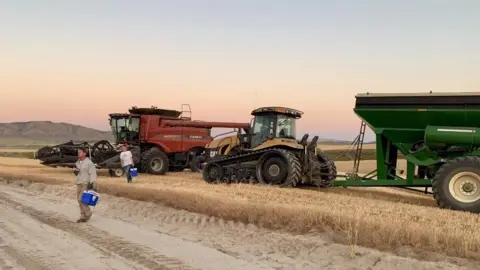
Last year, a study published in scientific journal Nature warned of the potentially dire consequences of numerous crop failures happening at the same time around the world, as a result of the impact of climate change.
“Simultaneous harvest failures across major crop-producing regions are a threat to global food security,” said the report, which was led by climate scientist Kai Kornhuber from Columbia University’s Lamont-Doherty Earth Observatory.
This warning comes as the world population is expected to reach 10 billion people by 2050, up from eight billion currently, according to the United Nations.
With increased pressure on crops, at the same time as the global population continues to grow, could AI be key to developing new varieties that can better cope with extremes of weather?
wSource link

